
How to work this course with your AI Assistant
- Open a new conversation That's what I'm talking about. No need to connect a trading account.
- Copy the prompt for each module. It already includes a fictitious case to start with. To use your own information, replace the case with a dated public source or an anonymous document.
- He runs and preserves the answer. If your tool supports files, attach a CSV or document; otherwise paste the table as text. For a chart, provide the data and request axes, units and assumptions.
- Check the result with monitoring values and course charts. A capture can help describe but an exact figure can be checked by a table.
- He called for a concrete correction and repeat the task. That the AI will review itself doesn't replace your check.
The buttons copy instructions. The answer can be obtained by gluing them to your assistants and this page does not automatically check an AI model. Do not share credentials or personal information.
Convert an announcement to verifiable questions with AI
Solve with A · step by step
- What to give to the AI. Fictitious announcement: housing €200.000, rental expected €1.000 / month. No simple note, area verified, community expenses and technical status are provided.
- What to ask. Extract statements from the announcement and build a table: statement, necessary evidence, status of verification and outstanding question. Don't make up loads, surface and rent.
- That's something to check with you. Price and rent are figures from the listing, not verified market facts. The property registry extract, receipts and technical condition remain unchecked.
Propt ready to run
See the expected result and how to fix it
Independent monitoring: Price and rent are figures from the listing, not verified market facts. The property registry extract, receipts and technical condition remain unchecked.
These values are a didactic solution calculated with the case and are not a real response obtained from a model.
Follow-up request: Check your table and separate documents that exist in the case of documents that should only be requested.
Your AI exercise: run the prompt, compare the response with the monitoring and send the monitoring request. Write down a correct dataset, an omission or limit and how the response changes. If you don't get an error, check two statements anyway.
Concepts to check what the AI responds to
A housing isn't a performance figure. It can have loads, community expenses, outstanding works, user constraints, periods without tenant and sales costs. Also, it's not an asset that you can always sell quickly or at the price you want. We will use the AI to order documents and questions, never to replace registration, technical or legal checks.
The fictitious case is a flat announced by 200.000 € with an expected income from 1.000 €per month. A quick division suggests 6% gross per year. Before we take that figure seriously we have to know the total investment, whether the income is attainable and what expenses would come with the owner.
4 sources performing different functions
- Property registration: Requests up-to-date information about title, rights and loads. The simple note That's information and date.
- Cadastre: contrast reference, surface and cadastral data at official headquartersand does not replace the Register.
- Building and housing: Requests community document, status of installations, certificates and repair budgets.
- Market and local standards: contracts comparable rents and checks applicable rules of use, rental and tributes where the property is.
Exercise (1 minute). Do a table with four columns: statement of an announcement, document that I could check, date of document and outstanding doubt. If the data isn't documented, write "unverified."
Have AI cross document without filling gaps
Solve with A · step by step
- What to give to the AI. Fictitious extracts: an announcement says surface 80 m ² and a cadastral extract says 75 m ², with no useful or built information and no registration surface data. Community receipt: 60 €/ month.
- What to ask. Compare documents to a table with source, data, unit, contradiction or doubt and pending check. Do not choose an area as final and do not interpret legal rights.
- That's something to check with you. There's a difference of 5 m ² but the bases may not be comparable. The annual community expenditure is 720 €if it remains for 12 months and the registration area remains unchanged.
Propt ready to run
See the expected result and how to fix it
Independent monitoring: There's a difference of 5 m ² but the bases may not be comparable. The annual community expenditure is 720 €if it remains for 12 months and the registration area remains unchanged.
These values are a didactic solution calculated with the case and are not a real response obtained from a model.
Follow-up request: It sets out questions to explain what each area measures and what costs are included and does not substitute for a professional review.
Your AI exercise: run the prompt, compare the response with the monitoring and send the monitoring request. Write down a correct dataset, an omission or limit and how the response changes. If you don't get an error, check two statements anyway.
Concepts to check what the AI responds to
The AI can read public extracts and build a list of questions, but it's easy to mix data from different housing or misinterpret a clause. Give them only relevant documents, date and provenance. If there's personal information from vendors or tenants, remove them before using a public tool.
| Fact of the case | Proper source | What can go wrong |
|---|---|---|
| Surface and description | Registration, registration and technical visit | Differences between documents or useful and built area |
| Loan and title | Recent registration information | Old document or right document limiting use |
| Estimated income | Comparable contracts and local market | To merge price ordered with income actually charged |
| Expenditure and construction | Recipes, community and monitoring | To avoid future losses or repairs |
If financing is envisaged, it calls for conditions and total costs of the loan separately. The Bank of Spain explain the expenses associated with the mortgage. Sales and lending costs are different concepts and do not apply them a fixed figure from a video or a template.
Propt 1 · Review a property
Calculates with AI profitability on a complete basis
Solve with A · step by step
- What to give to the AI. Hypothetical model: price 200,000 €, acquisition costs 20,000 €, rent 1,000 €/month, 1 vacant month, annual ordinary expenses 3,000 €. Excludes financing and personal taxes.
- What to ask. It calculates total investment, theoretical income, earned income, operational income, gross return on price and operational on total investment. It shows denominators and formulas.
- That's something to check with you. You have to get 220.000 €, 12.000 €, 11.000 €, 8.000 €, 6% and 3,64%. Operating income isn't final gain after mortgage and tax.
Propt ready to run
See the expected result and how to fix it
Independent monitoring: You have to get 220.000 €, 12.000 €, 11.000 €, 8.000 €, 6% and 3,64%. Operating income isn't final gain after mortgage and tax.
These values are a didactic solution calculated with the case and are not a real response obtained from a model.
Follow-up request: It emits the excluded components and labels as an assumption every amount that isn't supported by a document.
Your AI exercise: run the prompt, compare the response with the monitoring and send the monitoring request. Write down a correct dataset, an omission or limit and how the response changes. If you don't get an error, check two statements anyway.
Concepts to check what the AI responds to
Educational assumptions: purchase price 200.000 €and purchase costs 20.000 €rental 1.000 €/ monthan empty year and regular expenses of the owner of 3,000 €/year. The purchase costs are a financial year assumption and are not a universal legal percentage. The total investment of the case is €220.000.
The annual operational income before financing and personal taxes is 11.000 − 3.000 = 8.000 €. In this model, the operational profitability especially of the acquisition capital is 8.000) 220.000) 3,64%. The gross uses only theoretical price and income and the operative uses a more complete basis and remains without final gain.
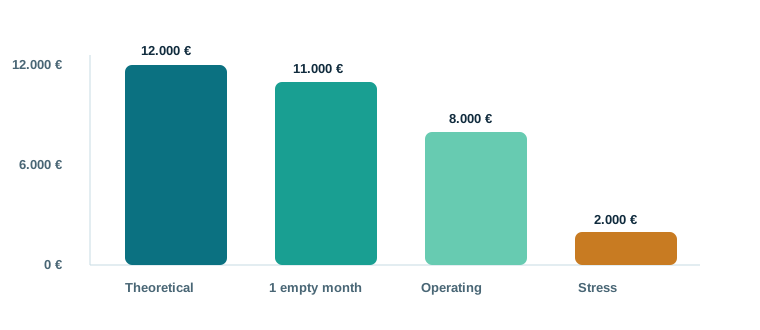
A rise in housing prices does not appear in this figure, nor does the costs of selling them. To compare alternatives, maintain the same definition of profitability and the same period. A property can have an apparent high income and require a reform that changes the whole account.
Requests an A table and a sensitivities graph
Solve with A · step by step
- What to give to the AI. The same hypothetical property: investment 220,000 €, monthly rent 1,000 €, ordinary expenses 3,000 €/year. Scenario A: 1 vacant month and no additional repairs. B: 3 vacant months and repairs of 4,000 €.
- What to ask. Calculates income earned, operational income and operational profitability for A and B. He creates a board and, if you can, a bar graph. He adds scenarios with 0,1,2,3 empty months changing only that variable and without repair.
- That's something to check with you. A production of 8.000 €and been 3,64%. B produces €2.000 and .0,91%. Don't assign an opportunity to empty without data.
Propt ready to run
See the expected result and how to fix it
Independent monitoring: A production of 8.000 €and been 3,64%. B produces €2.000 and .0,91%. Don't assign an opportunity to empty without data.
These values are a didactic solution calculated with the case and are not a real response obtained from a model.
Follow-up request: Check if by comparing A and B they change two variables and separate their effect with an intermediate scenario and display the calculations.
Your AI exercise: run the prompt, compare the response with the monitoring and send the monitoring request. Write down a correct dataset, an omission or limit and how the response changes. If you don't get an error, check two statements anyway.
Concepts to check what the AI responds to
The figure's adverse scenario has been 3 months empty and an extraordinary remedy of 4.000 €. Rent collected would be 9,000 €, leaving 2,000 € after 3,000 € of ordinary expenses and 4,000 € of repairs, before financing and personal taxes: 0,91 % of EUR 220.000. The model does not say that this scenario will come about and shows the sensitivities to contingencies.
Educational real estate calculator
It does not include financing, personal taxation, inflation, sales and market changes.
Exercise (1 minute). Introduce three vacant months and 4,000 € of repairs. Check that operating income falls to 2,000 €. Then consider which real documents you would need to estimate the likelihood and cost of those repairs.
If you ask for a mortgage, the operating income isn't the remaining flow after your share. It adds separate interest, amortization, variable conditions and liquidity reserves. A fee does not turn a purchase into "free" because the rent cover a few months.
Use the AI to audit the omissions of a comparison
Solve with A · step by step
- What to give to the AI. Fictitious Abstract: "The property rents 6%, so all expenses are paid." Data: theoretical income €12.000, price €200.000, total investment €220.000, an empty month, regular expenditure €3.000, with no financial and tax data.
- What to ask. Audit the summary: statement, correct calculation, missed cost and outstanding data. Write a descriptive conclusion without recommending purchase.
- That's something to check with you. 6% are gross about prices and cannot be shown to cover all expenses. The operation is 8.000 €before financing and taxes.
Propt ready to run
See the expected result and how to fix it
Independent monitoring: 6% are gross about prices and cannot be shown to cover all expenses. The operation is 8.000 €before financing and taxes.
These values are a didactic solution calculated with the case and are not a real response obtained from a model.
Follow-up request: Prepare a list of documents and questions to complete the model and do not invent tax rates or mortgage conditions.
Your AI exercise: run the prompt, compare the response with the monitoring and send the monitoring request. Write down a correct dataset, an omission or limit and how the response changes. If you don't get an error, check two statements anyway.
Concepts to check what the AI responds to
A good review does not ask "Is that good investment?" but "What's missing and what changes if the assumption goes worse?" The AI cannot inspect a housing, check a real-time load or get to know today's local standards with no source. It contrasts any statement with a professional and with the appropriate administration.
Propt 2 · Scenarios and Doubts
Check what you have learned
1. Why isn't 6% gross equal to available money?
A share of €12.000 theoretical about €200.000 of prices, with no jobs, costs and purchase costs. For the base case, the operating income is 8.000 €about 220.000 €, about 3,64% before financing and personal taxes.
2. What remains after three vacant months and 4,000 € of repairs?
9,000 € rent collected − 3,000 € ordinary expenses − 4,000 € extraordinary expenses = 2,000 €. This is a hypothetical scenario, not a forecast.
3. Do the information from the cadastre replace the simple registration note?
No. They perform different functions. It contrasts both documents, their date, actual status and doubts with appropriate professionals.
Performance of the course
Now you can move from an announcement to a list of verifications and from gross profitability to several operational scenarios. The AI organizes questions, and the document and physical check support the evaluation.
Back to course →Sources for deepening
- Registrators: simple note and Property Registration.
- The electronic headquarters of the cadastre.
- Bank of Spain: mortgage related expenses.
Educational content with property and fictitious amounts. It does not constitute financial, fiscal or legal advice or purchase recommendation.