
How to work this course with your AI Assistant
- Open a new conversation That's what I'm talking about. No need to connect a trading account.
- Copy the prompt for each module. It already includes a fictitious case to start with. To use your own information, replace the case with a dated public source or an anonymous document.
- He runs and preserves the answer. If your tool supports files, attach a CSV or document; otherwise paste the table as text. For a chart, provide the data and request axes, units and assumptions.
- Check the result with monitoring values and course charts. A capture can help describe but an exact figure can be checked by a table.
- He called for a concrete correction and repeat the task. That the AI will review itself doesn't replace your check.
The buttons copy instructions. The answer can be obtained by gluing them to your assistants and this page does not automatically check an AI model. Do not share credentials or personal information.
Organises with target, term and liquidity AI
Solve with A · step by step
- What to give to the AI. Fictitious case: target A requires money within 3 years and target B within 15. No personal liability, product and tolerance of risk are provided.
- What to ask. It creates two research sheets with goal, horizon, liquidity need, outstanding data and questions. Don't recommend a portfolio and have a profitability.
- That's something to check with you. The AI should differentiate periods and needs without inventing an asset assignment or claiming that 15 years guarantees recovery.
Propt ready to run
See the expected result and how to fix it
Independent monitoring: The AI should differentiate periods and needs without inventing an asset assignment or claiming that 15 years guarantees recovery.
These values are a didactic solution calculated with the case and are not a real response obtained from a model.
Follow-up request: It identifies what information sheet questions require personal judgment and what can be responded to with document from a product.
Your AI exercise: run the prompt, compare the response with the monitoring and send the monitoring request. Write down a correct dataset, an omission or limit and how the response changes. If you don't get an error, check two statements anyway.
Concepts to check what the AI responds to
"Long term investment" does not mean that any asset will recover or that you can ignore the risk. The starting point is the purpose of the money: when you will need it, what temporary loss you could have and what part should be available. The CNMV recommends defining target, term and assumed risk before choosing products.
We'll work with a wallet. Fictida of €10.000 and an illustrative horizon of 15 years. We will have no choice of a particular product and we will have no assumption that the market will have a fixed profitability. The AI will serve to order documents and submit a thesis to difficult questions.
Filling information
- Objective: write about what money and an approximate date of use would be reserved for.
- Liquidity: separate what you might need before that date.
- Risk: write down what fall in euro would make you rethink the plan and why.
- Product: identifies underlying assets, costs, currency and terms of sale.
- Review: set what data you will observe and how much, without reacting to each holder.
Exercise (1 minute). Write two different objectives, such as an expense in three years and another in fifteen. Why should they not be assessed using the same liquidity requirement?
Expand with AI data that support or weaken a thesis
Solve with A · step by step
- What to give to the AI. Fictitious company Rio Azul: revenues 100 → 110, operating flow 18 → 11, debt 30 → 45. Same units and two comparable periods. The cause of the changes cannot be explained.
- What to ask. It creates a table with an absolute and percentage variation, fact, interpretation and data necessary to verify it. It forms a provisional thesis and conditions that would invalidate it.
- That's something to check with you. Variations: + 10%, − 38,89% and + 50%. The causes have to be hypotheses and are not in the data.
Propt ready to run
See the expected result and how to fix it
Independent monitoring: Variations: + 10%, − 38,89% and + 50%. The causes have to be hypotheses and are not in the data.
These values are a didactic solution calculated with the case and are not a real response obtained from a model.
Follow-up request: Find an argument contrary to your thesis using the same data. Don't make up news, valuation ratios and future benefits.
Your AI exercise: run the prompt, compare the response with the monitoring and send the monitoring request. Write down a correct dataset, an omission or limit and how the response changes. If you don't get an error, check two statements anyway.
Concepts to check what the AI responds to
A long-term thesis isn't "this action will come up." That's an explanation of what would have to happened for a company, fund or portfolio to achieve your goal, what data support the idea and what results would invalidate it. For a company, start with audited accounts, cash flow, debt and published risks. For a fund, read prospectus, investment policy, composition and cost document.
Imagine Fictitious Company Blue River. His income increased from 100 to 110 in a year but his cash flow fell from 18 to 11 and his debt increased from 30 to 45. "Sales + 10%" is true but insufficient. The useful question was why cash and debt had been moved otherwise. The AI can get figures, but you have to check each of them in the original document and its date.
| Fictitious data | Previous year | Current year | Question |
|---|---|---|---|
| Income | 100 | 110 | Do growth come from recurrent sales? |
| Operating flow | 18 | 11 | Did they increase outstanding collection or inventory? |
| Debt | 30 | 45 | How much does it cost to fund and when does it come to an end? |
A good company cannot be sufficient: the price paid and the risks matter. Nor does a fall in contribution itself prove that the theses are broken. Distingue change of price of change in the facts of the business.
Propt 1 · Extract and contrast
He called on the AI to have a clear simulation of costs
Solve with A · step by step
- What to give to the AI. Fictitious model: initial capital €10.000, 15 years old, constant gross growth 5%, cost A 0,2% and cost B 1,2% applied after growth. Annual formula: balance × 1,05 × (1 − cost).
- What to ask. Calculates a table of balances per year for A and B and the final difference. If you can, print both sets. He's tagging growth as an assumption, not foresight. It excludes taxes and inflation only because that's what the exercise defines.
- That's something to check with you. The final rounded balances are approximately €20.174 and €17.346. Check at least first year: 10.479 €and 10.374 €.
Propt ready to run
See the expected result and how to fix it
Independent monitoring: The final rounded balances are approximately €20.174 and €17.346. Check at least first year: 10.479 €and 10.374 €.
These values are a didactic solution calculated with the case and are not a real response obtained from a model.
Follow-up request: Repeat with an assumed 0% growth and explain what part of the result changes with the model, without concluding what product to buy.
Your AI exercise: run the prompt, compare the response with the monitoring and send the monitoring request. Write down a correct dataset, an omission or limit and how the response changes. If you don't get an error, check two statements anyway.
Concepts to check what the AI responds to
The graph isolates only the effect of two level costs per year. Part of €10.000, represents a constant 5% gross each year for 15 years and applying the after-growth cost: balance × 1,05 × (1 − cost). That constant rate does not represent a real market or a foresight. We did not include taxes, inflation and money movements.
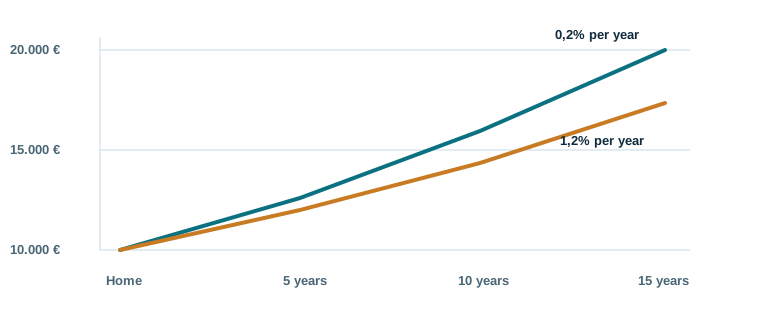
At the end, the first assumption gives about 20.174 € and the second 17.346 €: a difference from 2.828 €. The cheapest product isn't automatically suitable: it compares what it holds, the risk assumed, the service included and the other costs. The SEC explain how spending reduces capital that keeps growing.
Educational cost simulator
Projected constant performance, annual capitalisation and costs applied each year.
Use AI to comput inputs and detect overlap
Solve with A · step by step
- What to give to the AI. Fictitious inputs: 100 €every month at prices 10 €, 8 €and 12 €with fractions and without costs. Founding funds A and B: both have company X and have no pesos.
- What to ask. Calculates units per month, total units and average cost per unit. He then detects a known overlap between A and B and what's missing to measure.
- That's something to check with you. Total units 30,8333, mean cost ю 9,73 €. It's known that there's overlap at X, but its magnitude without weights.
Propt ready to run
See the expected result and how to fix it
Independent monitoring: Total units 30,8333, mean cost ю 9,73 €. It's known that there's overlap at X, but its magnitude without weights.
These values are a didactic solution calculated with the case and are not a real response obtained from a model.
Follow-up request: Refigure the third month at 20 €. Distinguish the contribution schedule from the potential for future loss.
Your AI exercise: run the prompt, compare the response with the monitoring and send the monitoring request. Write down a correct dataset, an omission or limit and how the response changes. If you don't get an error, check two statements anyway.
Concepts to check what the AI responds to
Reparation between assets with different risks can reduce the dependence of a single company or sector but does not eliminate general market losses. Check if several seemingly different funds have the same big companies. The SEC describes diversification and asset assignment as parts of risk monitoring.
A regular lump sum contribution buys more units when prices are low and less when they are high. A mathematical example with fractions and without costs: inputs 100 € in each of three months at prices 10 €, 8 €and 12 €. You get 10 and 12,5 and 8,33 30,83 unitsThe average cost per unit is approximately 9,73 €. That doesn't guarantee benefits: the future price could be lower.
| Fictitious months | Input | Price | Approximate units |
|---|---|---|---|
| 1 | 100 € | 10 € | 10,00 |
| 2 | 100 € | 8 € | 12,50 |
| 3 | 100 € | 12 € | 8,33 |
That method organises the schedule but does not transform an inappropriate asset into insurance. It verifies commissions, minimum measures, applicable taxation and whether fractions are permitted. The SEC defines regular fixed amount investmentThe result depends on the market.
Exercise (1 minute). Calculates how many units you would buy in 3 months if the price was €20 instead of €12. Do you change the amount? The method protects you from a later fall?
Submit your thesis to a critical review with AI
Solve with A · step by step
- What to give to the AI. Educational Thesis: "Sales are growing, so business's better." Fictitious facts: income + 10%, operating flow − 38,89%, debt + 50%. No information about cases or valuation.
- What to ask. He lays out a favourable argument, an opposite argument, omissions and information that would allow his thesis to be revised. It secures interpretation and doesn't recommend investing.
- That's something to check with you. The review should not match bigger sales with demonstrated improvement of the whole business. He's got to sign his flow and his debt without making up his cause.
Propt ready to run
See the expected result and how to fix it
Independent monitoring: The review should not match bigger sales with demonstrated improvement of the whole business. He's got to sign his flow and his debt without making up his cause.
These values are a didactic solution calculated with the case and are not a real response obtained from a model.
Follow-up request: Deliver a monitoring table with fact to be checked, required document, outstanding date and status of review.
Your AI exercise: run the prompt, compare the response with the monitoring and send the monitoring request. Write down a correct dataset, an omission or limit and how the response changes. If you don't get an error, check two statements anyway.
Concepts to check what the AI responds to
A review separates structural market noise changes. Programme when to review the target and record what events would repropose the portfolio. Do not give an A public account extracts, personal information and credentials. The ESMA warns that AI can offer incorrect or outdated information.
Propt 2 · Critical Committee
Check what you have learned
1. Why aren't they trying to get back a loss for 15 years?
A company, sector or market can lose value for long periods and your needs can change. The term does not create a guaranteed profitability.
2. What's missing from the cost chart to look like an actual investment?
Variations between years, potential losses, inflation, taxes, contributions or withdrawals and other costs. It only isolates two committees.
3. What's the approximate average cost of the three inputs?
300 €) 30,83 units) 9,73 €per unit if fractions are allowed and there are no costs.
Performance of the course
Now you can propose an objective, document a thesis with sources, compare costs and detect concentration. The AI helps you ask better questions and the original data and your needs continue to mark the decision.
Back to course →Sources for deepening
- CNMV: how to make investment decisions.
- SEC: asset assignment and diversification.
- SEC: Impact of costs.
- ESMA: risks of using AI while investing.
Educational content with companies and figures. It does not constitute financial advice or an investment recommendation.