
How to work this course with your AI Assistant
- Open a new conversation That's what I'm talking about. No need to connect a trading account.
- Copy the prompt for each module. It already includes a fictitious case to start with. To use your own information, replace the case with a dated public source or an anonymous document.
- He runs and preserves the answer. If your tool supports files, attach a CSV or document; otherwise paste the table as text. For a chart, provide the data and request axes, units and assumptions.
- Check the result with monitoring values and course charts. A capture can help describe but an exact figure can be checked by a table.
- He called for a concrete correction and repeat the task. That the AI will review itself doesn't replace your check.
The buttons copy instructions. The answer can be obtained by gluing them to your assistants and this page does not automatically check an AI model. Do not share credentials or personal information.
Prepare the session with a list created by AI
Solve with A · step by step
- What to give to the AI. Fictitious meeting ALFA / EUR. Available information: closed candles with 5 min and intended costs. Absentee data: official event schedule, spread and liquidity. No news source has been provided.
- What to ask. It creates a list of preparations: information available, data absent, necessary source and condition that prevents an input from being evaluated. Do not make up news or interpret the absence of a calendar as an absence of events.
- That's something to check with you. The AI should report schedule, spread and liquidity as outstanding. A complete list organizes his work and doesn't make his case an operable one.
Propt ready to run
See the expected result and how to fix it
Independent monitoring: The AI should report schedule, spread and liquidity as outstanding. A complete list organizes his work and doesn't make his case an operable one.
These values are a didactic solution calculated with the case and are not a real response obtained from a model.
Follow-up request: He ordered challenges for their effect on his case assessment and explained why, without assigning a probability of success.
Your AI exercise: run the prompt, compare the response with the monitoring and send the monitoring request. Write down a correct dataset, an omission or limit and how the response changes. If you don't get an error, check two statements anyway.
Concepts to check what the AI responds to
The intricate trading opens and closes positions during the same session. It requires continuous care, quick decisions and monitoring of costs. The AI can order news, sum up a schedule and turn your rules into a checklist. He cannot know with certainty where his next price will go.
To learn, we will work with a Fictitious action called Example S.A. and a simulated session. That is not an actual contribution or an invitation to conduct operations. The aim is to build a process that can be revised later, even if the result is negative.
Pre-session information sheet · 2 minutes
- Instrument: identifies market, time, habitual liquidity and product type. If you use derivatives, understand their leverage and their specific costs.
- Information: economic calendar consultation, emitter's communications and official news with hour and source. A date-free incumbent isn't good enough.
- Conditions: score spread, commissions, potential interruptions and volatility. The visible price may not be the execution price.
- Risk: set a maximum session loss, a hypothetical position size and the situations in which you would not trade.
- Retirement: He writes two scenarios that can be invalidated with observable data.
Before we start: frequent trading can lead to significant losses. Don't use money necessary for vital expenses. If the product is a CFD, the CNMV explain its risks and peculiarities. Also check your middleman's conditions and jurisdiction.
Analyzes the graph with A without applying for a prediction
Solve with A · step by step
- What to give to the AI. Hypothetical data: reference 100.20 €; invalidation 99.70 €; illustrative target 101.20 €. Only a screenshot of the course chart is supplied, not a complete OHLC table.
- What to ask. Just describe what's visible. Separates observation, hypotheses and missing data. If a price isn't read clearly, say so. Do not say that there was an execution and an intravele retest if they are missing as high and as low.
- That's something to check with you. Compare every figure with the graph. The response should not turn the target into an estimate or withdraw illegible prices. For exact calculations use a table.
Propt ready to run
See the expected result and how to fix it
Independent monitoring: Compare every figure with the graph. The response should not turn the target into an estimate or withdraw illegible prices. For exact calculations use a table.
These values are a didactic solution calculated with the case and are not a real response obtained from a model.
Follow-up request: It indicates what columns should be put into a CSV to check the rule and what information about execution remains missing.
Your AI exercise: run the prompt, compare the response with the monitoring and send the monitoring request. Write down a correct dataset, an omission or limit and how the response changes. If you don't get an error, check two statements anyway.
Concepts to check what the AI responds to
That figure shows Invented data A morning. Their horizontal lines are established work standards before To get to know the later course: 99,70 €as an invalidation, 100,20 €as a reference and 101,20 €as a target of a stage. They're no sign to be used in the market.
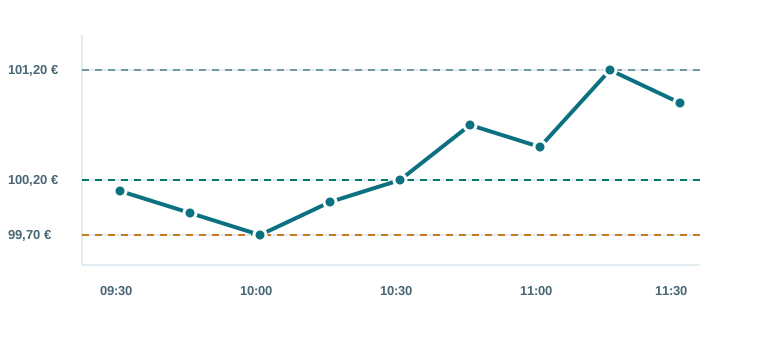
Scenario A: If the price regained the reference and the volume and terms and conditions to be accompanied, a simulated operation with defined invalidation would be studied. Scenario B: if it fell below 99.70 €, the hypothesis would no longer make sense and would be discarded. In both cases, doing nothing is a valid decision.
Looking at the graph already finished, it looks easy to choose the exact reference. In real time, you don't know the following points. That's why you have to. record the rules before and then compare what happened with what you had been planning. Nor does the touch of the target guarantee an enforcement at that price.
Exercise (1 minute). Mentally hide the chart to the right of 10:30. Write down the data you would confirm before acting and the observation that would invalidate your hypothesis. Then reveal the rest. The lesson is about the quality of the prior rule, not hindsight accuracy.
Calculates with AI the result after costs
Solve with A · step by step
- What to give to the AI. Fictitious long case: entry 100,20 €, stop 99,70 €, target 101,20 €, 40 units, total back and forth cost 5 €. No slip at the base calculation.
- What to ask. Calculates projected net loss, hypothetical net gain, gain / loss ratio and success rate to cover costs. Show all the steps. Refigure the loss for an output at 99,60 €.
- That's something to check with you. You have to get 25 €, 35 €, 1,4 and 41,67%. With an output at 99,60 €, the loss is 29 €. He's contrasting with his course calculator.
Propt ready to run
See the expected result and how to fix it
Independent monitoring: You have to get 25 €, 35 €, 1,4 and 41,67%. With an output at 99,60 €, the loss is 29 €. He's contrasting with his course calculator.
These values are a didactic solution calculated with the case and are not a real response obtained from a model.
Follow-up request: Repeat the stage with total costs of 8 €and explain why a gross target isn't sufficient to evaluate the operation.
Your AI exercise: run the prompt, compare the response with the monitoring and send the monitoring request. Write down a correct dataset, an omission or limit and how the response changes. If you don't get an error, check two statements anyway.
Concepts to check what the AI responds to
Let us only have a reference of 100,20 €, an invalidation at 99,70 €, a target at 101,20 €and 40 units for the exercise. The total back and forth cost, including an estimate of spread, commissions and slipping, is €5. The example presupposes that enforcement takes place at the prices indicated and can actually be worse.
The ratio of 1,4 does not indicate that the stage is probable or profitable. He's only comparing two so-called results. If a model with net gain of €35 and net loss of €25 were repeated many times, more than 41,7 % at times to exceed costs in that simplified model: 25 ″ (25 + 35). The actual success rate is unknown and may change.
If the negative output price was €99,60 per slip, the loss would have been increased to 29 €: (100,20 − 99,60) × 40 + 5. A stop order doesn't secure the price. Watch how a ten-cent movement changes the result.
A hypothetical stage calculator
Modifies values and compares results. Do not size an operation for your heritage or predict the probability of success.
It's supposed to be exact execution at prices introduced. It includes no tax or other potential losses.
Requests AI to compare plan and implementation
Solve with A · step by step
- What to give to the AI. Fictitious plan: entrance 100,20 €, stop 99,70 €, target 101,20 €, 40 units and assumed cost 5 €. Simulated registration: 100,25 €will be entered, 99,60 €will be released, 6 €actual cost.
- What to ask. It builds a table plan versus implementation: price, units, cost and result. It calculates the run loss and differentiates deviation, unknown cause and compliance that cannot be checked.
- That's something to check with you. The recorded loss is (100,25 − 99,60) × 40 + 6 = 32 €. Do not assign the slip to a concrete cause with no data.
Propt ready to run
See the expected result and how to fix it
Independent monitoring: The recorded loss is (100,25 − 99,60) × 40 + 6 = 32 €. Do not assign the slip to a concrete cause with no data.
These values are a didactic solution calculated with the case and are not a real response obtained from a model.
Follow-up request: It indicates what information remains to check whether the entry condition was met and whether the output change responded to a previous rule.
Your AI exercise: run the prompt, compare the response with the monitoring and send the monitoring request. Write down a correct dataset, an omission or limit and how the response changes. If you don't get an error, check two statements anyway.
Concepts to check what the AI responds to
The AI is useful when you get clear data: an official schedule, your written rules and a record of results. Ask him to separate facts, Retirement and Absentee data. It requires a date and a source for every fact. Avoid asking for "today's best entry" or relying on a prediction without a verifiable method.
Propt 1 · Prior preparation
The paper allows to detect faults that a positive result can hide. If you make money by breaking your own rules, you haven't validated the process. He independently lays down his previous idea, his execution and his result. Do not share with a public assistant account identifier, keys and personal information.
| Fictional case registration | Before the meeting | Following the sitting |
|---|---|---|
| Retirement | Recovery of 100,20 €under defined conditions | Did it come true without re-interpreting the rule? |
| Invalidation | 99,70 € | Did the actual exit match? That's a slip. |
| Expected costs | 5 €back and forth | It's about real costs and difference. |
| Conduct | A simulated decision or no decision | Did you wait for the condition? Did you change the plan? |
Propt 2 · Review without bias
Solves a simulated session with AI help
Solve with A · step by step
- What to give to the AI. Fictitious case: Input 100,20 €, invalidation 99,70 €, target 101,20 €, 40 units, total costs 8 €. The later sequence first plays 99,70 €and after 101,20 €.
- What to ask. Rewrite a session paper applying the plan's exit at first touch. Calculates the net result and explains if the later bounce changes that result. Separates result and process quality.
- That's something to check with you. The base loss is 28 €under exact run. Rebound doesn't change an operation that's been closed. The sequence itself does not prove that the entry was valid.
Propt ready to run
See the expected result and how to fix it
Independent monitoring: The base loss is 28 €under exact run. Rebound doesn't change an operation that's been closed. The sequence itself does not prove that the entry was valid.
These values are a didactic solution calculated with the case and are not a real response obtained from a model.
Follow-up request: Check your paper for future information, invented data and missed costs. Reforms a revised version without adding operations.
Your AI exercise: run the prompt, compare the response with the monitoring and send the monitoring request. Write down a correct dataset, an omission or limit and how the response changes. If you don't get an error, check two statements anyway.
Concepts to check what the AI responds to
Before we finish, get back to the graph and make these three decisions. in writing. First, indicate what condition you would observe before setting stage A. Second, decide what to do if the price falls under 99,70 €without having acted. Thirdly, it emphasizes the loss if the total cost goes up from 5 €to 8 €: with 40 units and output to 99,70 €, how much would that be? Then check the answer and the reasoning, and not just the result.
Check what you have learned
1. Why isn't it enough that the graph touched 101,20 €?
Because the tour is known only after, the prior condition may have been met and a real order may not have been performed at that price. Moreover, the net result depends on costs and slipping.
2. What's the intended loss with an entry 100,20 €, an output 99,70 €, 40 units and 8 €of costs?
(100,20 − 99,70) × 40 + 8 = 28 €. That's still an estimate. A worse way out would have increased his loss.
3. If a simulation makes money but doesn't fulfill your rule of invalidation, what do you write down?
That the result was positive and that the process failed to fulfill the rule. They're different observations. An operation isn't worth a strategy.
Performance of the course
Now you have a routine: check sources before the session, write scenarios and invalidation, compute net result, simulate and review the paper. The AI helps to order and question data and market uncertainty remains.
Back to course →Sources for deepening
- FINAL: risks and characteristics of intricate trading. The US account rules do not apply automatically in Spain.
- CNMV: characteristics and risks of CFDIf you study that product.
- ESMA: warning about AI and investment.
Educational content with fictitious prices. It does not constitute financial advice or an investment recommendation.