
How to work this course with your AI Assistant
- Open a new conversation That's what I'm talking about. No need to connect a trading account.
- Copy the prompt for each module. It already includes a fictitious case to start with. To use your own information, replace the case with a dated public source or an anonymous document.
- He runs and preserves the answer. If your tool supports files, attach a CSV or document; otherwise paste the table as text. For a chart, provide the data and request axes, units and assumptions.
- Check the result with monitoring values and course charts. A capture can help describe but an exact figure can be checked by a table.
- He called for a concrete correction and repeat the task. That the AI will review itself doesn't replace your check.
The buttons copy instructions. The answer can be obtained by gluing them to your assistants and this page does not automatically check an AI model. Do not share credentials or personal information.
Expand with AI the rules of an assessment
Solve with A · step by step
- What to give to the AI. Fictitious conditions: initial account €10.000. Target: + 8%. Daily loss: 5% of initial account, including open losses and costs. Total loss: 10% of initial account with fixed ground. The text does not specify time and minimum day re-start.
- What to ask. Extract a table with rule, formula, calculation reference, short quote and outstanding data. Don't report re-starting hours or minimum days.
- That's something to check with you. The table should mark the re-start and minimum days as "unlisted." The total fixed ground is 9.000 €and should not become a mobile boundary.
Propt ready to run
See the expected result and how to fix it
Independent monitoring: The table should mark the re-start and minimum days as "unlisted." The total fixed ground is 9.000 €and should not become a mobile boundary.
These values are a didactic solution calculated with the case and are not a real response obtained from a model.
Follow-up request: Separate what the text says from your assumptions. Remove every condition that is not cited and formulate two questions to clarify missing information.
Your AI exercise: run the prompt, compare the response with the monitoring and send the monitoring request. Write down a correct dataset, an omission or limit and how the response changes. If you don't get an error, check two statements anyway.
Concepts to check what the AI responds to
A Founding Account usually starts with a Evaluation:: you have to achieve some goals and have to respect loss limits. The commercial names may suggest that you get money to invest, but the operation can be developed in a simulated environment and conditions for access to potential payments depend on the contract. Before you pay, figure out exactly what you're buying.
The usual error is to be set only at the profit target. To figure out if the challenge matches your way of operation, you need a complete rule sheet. The AI serves to order the contract and point to contradictions and cannot guarantee that you approve or replace the reading of the original terms.
Your first fact sheet
- Objective: what results are requested and within what time frame.
- Daily loss: amount, calculation basis, time and time area of reset.
- Total loss: ground or mobile, and if it changes as the balance goes up.
- Equity: if they have open losses, commissions and other charges.
- Operating permitted: assets, schedules, news, maintenance and automated systems.
- Cost and payments: Retirement, terms and conditions and grounds for cancellation.
Some firms, for example, calculate the daily limit with account value including open positions and costs and distinguish between static and mobile ceilings. The exact definition depends on the program. Always check with the actual document of the concrete signature, not a capture or a summary generated by AI.
Requests the AI to translate the rules into euro
Solve with A · step by step
- What to give to the AI. Fictitious case: counts €10.000, target 8%, daily loss 5% on initial balance, total loss 10% with fixed ground.
- What to ask. Calculates money target, daily loss, total loss and total soil. Sample formula, replacement and result. Add a column with what this calculation doesn't let you know.
- That's something to check with you. Check €800, €500, €1.000 and €9.000. Reinitiation time cannot be deducted from a percentage.
Propt ready to run
See the expected result and how to fix it
Independent monitoring: Check €800, €500, €1.000 and €9.000. Reinitiation time cannot be deducted from a percentage.
These values are a didactic solution calculated with the case and are not a real response obtained from a model.
Follow-up request: Repeat calculations for a fictitious account of €20.000 while maintaining the rules. Explain what changes and what remains unstated.
Your AI exercise: run the prompt, compare the response with the monitoring and send the monitoring request. Write down a correct dataset, an omission or limit and how the response changes. If you don't get an error, check two statements anyway.
Concepts to check what the AI responds to
We'll work with a Fictitious assessment EUR 10.000. The percentages of the table serve only to learn how to calculate. They do not describe any actual offers and are not recommended parameters for operation.
| Fictitious status | Calculation | Key amount / question |
|---|---|---|
| Initial balance | Sample basis | 10.000 € |
| Evaluation target: + 8% | 10.000 × 0,08 | 800 €; are there minimum trading days? |
| Daily limit: − 5% | 10.000 × 0,05 | EUR 500 and from what reference are we computing? |
| Total limit: − 10% | 10.000 × 0,10 | 1.000 €. Is it flat or mobile ground? |
| Daily re-initiation | Not deducted from percentage | Check time, time zone and open position effect. |
If the total limit was with respect to the starting balancethe hypothetical ground would be 9.000 €. If it were mobile, that ground could change as the account reached new tops. You cannot infer that from the words "10% maximum loss." He wants the formula and an official example.
Readying exercise (1 minute). Search the exact text that defines "daily loss" in the real terms of a signature. Write down if using closed balance or equity, what costs includes, how soon the day runs and what happens with an open position after re-start. If something doesn't come up, write Do not have.
This distinction changes decisions. An open position can reduce available headroom even before you close it. That is why, in our case, the next chart shows the illustrative equity, not just the balance of closed trades.
Building an AI session budget
Solve with A · step by step
- What to give to the AI. Fictitious assumptions: account €10.000, daily contractual limit €500, personal ceiling €200, planned loss €50 per operation, first model with no costs and no slipping.
- What to ask. It builds a table after 0, 1, 2, 3 and 4 consecutive losses: accumulated loss, equity, distance to personal top and distance to contractual ground. Define how soon the session will end with your personal cover.
- That's something to check with you. After four losses, the equity is €9.800 and the personal ceiling is reached. The distance to contractual ground is 300 €but that doesn't allow us to ignore the plan.
Propt ready to run
See the expected result and how to fix it
Independent monitoring: After four losses, the equity is €9.800 and the personal ceiling is reached. The distance to contractual ground is 300 €but that doesn't allow us to ignore the plan.
These values are a didactic solution calculated with the case and are not a real response obtained from a model.
Follow-up request: Refigure if the third loss is 70 €and there's another open position with − 80 €, indicating separately the scenarios with and without that position.
Your AI exercise: run the prompt, compare the response with the monitoring and send the monitoring request. Write down a correct dataset, an omission or limit and how the response changes. If you don't get an error, check two statements anyway.
Concepts to check what the AI responds to
In the fictitious example, the daily contractual limit is EUR 500. To practice, the pupil lays down a personal ceiling of 200 €a day and a hypothetical risk of 50 €per operation. They are supposed to be didactic, and they are not place size instructions.
The distance between both tops is 300 €. If four consecutive operations lose 50 €each, the equity goes from 10.000 €to 9.800 €. That's where the session ends as per his personal plan, even if his and his contractual daily production will be at €9.500.
The arithmetic looks simple but an operation can lose more than intended by slipping, commissions or fast movements and another open position also consumes space. A stop doesn't guarantee that the final loss will be exactly 50 €. It includes these costs and a worse stage in your plan.
Don't confuse two thresholds: The personal ceiling is an example planning decision. The contractual limit is a condition of an assessment and can lead to non-compliance. The figure that matters and its form of calculation have to come out of the terms currently in place.
A didactic calculator
Enter hypothetical percentages to convert them into euro. The tool calculates consecutive losses of constant size and includes no slip, costs and mobile rules.
Simplified calculation on initial balance.
Have the AI read the equity and check the stop
Solve with A · step by step
- What to give to the AI. Fictitious equity data: 10.000, 9.950, 9.900, 9.850, 9.800 €. Personal cover: €9.800. Fictitious daily ground: €9.500.
- What to ask. Create an observation table and, if you can generate graphs, draw the series with both tagged thresholds. It identifies the first observation that reaches the personal top. If you cannot graph, surrender the table without claiming that you have created an image.
- That's something to check with you. The first range is observation 5 counting the start as 1. The graph shows no intermediate movements or costs. Compare with the course chart.
Propt ready to run
See the expected result and how to fix it
Independent monitoring: The first range is observation 5 counting the start as 1. The graph shows no intermediate movements or costs. Compare with the course chart.
These values are a didactic solution calculated with the case and are not a real response obtained from a model.
Follow-up request: He describes how the classification would change if an equity observation was missing. Do not invent the missing value or time of non-compliance.
Your AI exercise: run the prompt, compare the response with the monitoring and send the monitoring request. Write down a correct dataset, an omission or limit and how the response changes. If you don't get an error, check two statements anyway.
Concepts to check what the AI responds to
The figure represents five equity states in a single fictitious session: before and after operation and after each of four losses of €50. To facilitate reading, we omits commissions and intermediate variations. In an actual assessment these details can be crucial.
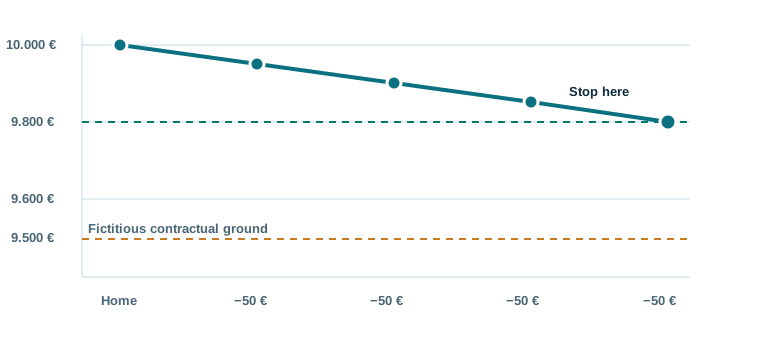
Reading: The fourth loss leads to a personal cover. To continue because "there are still 300 €up to the limit" contradicts the plan. If an open position also loses 80 €and the computa equity contract, these 80 €reduce the margin before closing the operation.
Adverse Test of 2 minutes
- Imagine that the third operation loses 70 €instead of 50 €for costs and slipping.
- Calculates equity after first three: 10.000 − 50 − 50 − 70 = 9.830 €.
- That's what we have. 30 € up to the personal top. A fourth operation with planned loss of 50 €no longer includes an example budget.
- Write a stop rule for that stage before simulate the session.
Check with A with your tab before you accept an overview
Solve with A · step by step
- What to give to the AI. Abstract invented to review: "Target 800 €, total ground 9.000 €, re-start at midnight and four losses of 50 €admitted." Fictitious source: €10.000, target 8%, fixed ground 90% and personal cover of the student €200. No re-initiation.
- What to ask. Audit each claim in the summary against the supplied sources. Return the claim, supporting evidence, calculation and status: correct, contradictory or not documented. Distinguish a contractual condition from a personal decision.
- That's something to check with you. That's bad at midnight. The personal ceiling of €200 should not be attributed to the contract. Four equal losses only fit into the model without extra costs.
Propt ready to run
See the expected result and how to fix it
Independent monitoring: That's bad at midnight. The personal ceiling of €200 should not be attributed to the contract. Four equal losses only fit into the model without extra costs.
These values are a didactic solution calculated with the case and are not a real response obtained from a model.
Follow-up request: It converts omissions into questions for signature and personal decisions into a separate dataset and doesn't make up answers.
Your AI exercise: run the prompt, compare the response with the monitoring and send the monitoring request. Write down a correct dataset, an omission or limit and how the response changes. If you don't get an error, check two statements anyway.
Concepts to check what the AI responds to
Copies a public extract of the terms of the signature into an AI assistant. Avoid uploading documents with personal data, credentials or account numbers. He then verifies every result in his original text. A convincing answer with no exact quote remains a hypothesis.
Propt 1 · Extract rules
Propt 2 · To put the plan under tension
Before you pay an assessment, check who's performing the service, whether the account's simulated or actual, the total price, the cancellation and collection rules, and the supervisors' warnings. The CNMV warns about frauds linked to phondeo courses and accounts. Consultation with Warning Seeker. An absence from the list does not amount to approval.
Check what you have learned
1. How much do they have to do with the daily and personal limits in our case?
€500 and €200, respectively: 10.000 × 5% and 10.000 × 2%. That's fictitious figures.
2. After how many losses of 50 €have been reached the personal ceiling?
After four: 4 × 50 €= 200 €. The illustrative equity remains at €9.800. with costs or slipping could be achieved earlier.
3. What do you do if AI doesn't find a daily re-start time?
The trademarks as "doesn't figure," you seek the original document and consultations with the firm before basing a decision on that rule. Don't take an invented hour.
Performance of the course
Now you can create a rule sheet, translate percentages into euro, recognize the difference between your top and the contractual and put an AI-supported plan to the test. If you can't explain a rule with a contract date and a numerical example, it's still unchecked.
Back to course →Sources for deepening
- FTMO Academy: explanation of maximum daily loss. Example of a signature, not general rule.
- FTMO: objectives and differences between programmes. It serves to watch how formulas change.
- CNMV: A guide to scams and frauds.
- ESMA: warning about the use of AI while investing.
Educational content. It does not provide financial advice, an investment recommendation or an assurance that an assessment will be completed.